Showing posts with label Gaming. Show all posts

20 April 2026

AI Decodes Lost Roman Board Game

An international team of researchers has successfully used AI to reconstruct the rules of a mysterious Roman-era board game carved into a limestone slab. The artifact, discovered in the ruins of the ancient town of Coriovallum, had puzzled archaeologists for decades due to its unique pattern of intersecting lines that did not match any known historical games. By utilizing high-resolution 3D scans to map microscopic wear patterns, the team identified where players had repeatedly slid game pieces across the stone. These physical fingerprints of play allowed researchers to use the AI-driven system Ludii to simulate over 100 possible rule sets, eventually narrowing down the most likely gameplay to a blocking game where one player attempts to trap the opponent's pieces.


The discovery, recently published in the journal Antiquity, marks a significant breakthrough in both archaeology and digital humanities, as it provides the first evidence that blocking games were played in Europe centuries earlier than previously documented. Dubbed Ludus Coriovalli (the Coriovallum Game), the reconstruction suggests a strategic two-player battle of wits that likely dates back to the late Roman period between AD 250 and 476. Beyond solving a 2,000-year-old mystery, this innovative marriage of AI simulation and use-wear analysis offers a powerful new toolkit for historians to resurrect lost cultural practices from artifacts that lack written records, proving that even the most silent stones still have stories to tell.

More information:

https://www.sciencenews.org/article/ai-roman-board-game-limestone
16 July 2025

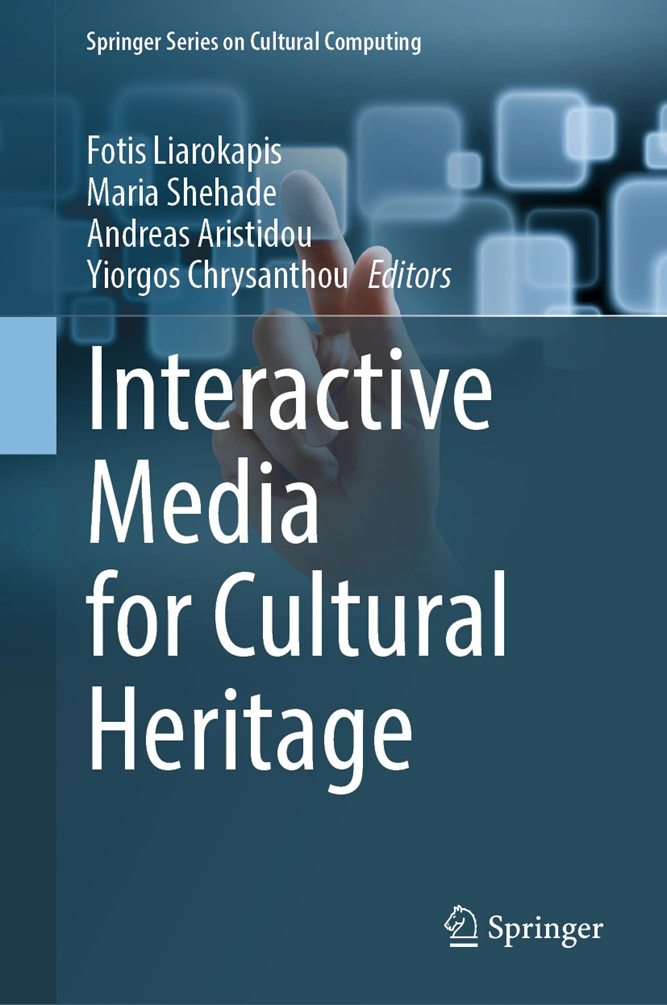
Interactive Media for Cultural Heritage

Recently, the latest edited book I co-authored with colleagues from CYENS – Centre of Excellence and the University of Cyprus was published by Springer Series on Cultural Computing. The book is entitled ‘Interactive Media for Cultural Heritage’ and presents the full range of interactive media technologies and their applications in Digital Cultural Heritage. It offers a forum for interaction and collaboration among the interactive media and cultural heritage research communities.

A close-up of a book cover

AI-generated content may be incorrect.

The aim of this book is to provide a point of reference for the latest advancements in the different fields of interactive media applied in Digital Cultural Heritage research, ranging from visual data acquisition, classification, analysis and synthesis, 3D modelling and reconstruction, to new forms of interactive media presentation, visualization and immersive experience provision via extended reality, collaborative spaces, serious games and digital storytelling.

More information:

https://link.springer.com/book/10.1007/978-3-031-61018-9

05 December 2023

Biotic Gaming

Biotic Games, blend actual biological elements and processes into digital gameplay. Typically featuring living micro-organisms, these games task players with manipulating bacterial behaviour using various stimuli such as electrical fields, chemicals, light, and so forth. These kinds of interactions are then translated into virtual characters and displayed on video gaming displays. Their accessible nature has made biotic games a favoured choice among diverse groups, including biology students, artists, and designers seeking to delve into the playful interactions between humans and the microbial world.

Many players are drawn to biotic games simply because of the novelty they offer. People are simply fascinated by the unusual aesthetics and peculiar appearances, such as those found in microbes. Further still, the fact that these organisms are alive adds another layer of fascination, demonstrating the concept of biophilia and our natural curiosity and attraction toward all living things. Finally, Internet-based biotic gaming would prove useful from a practical point of view. It would allow off-site gaming, whereby players are safely away from potentially harmful biological interactions.

More information:

https://medium.com/@rphlkim/playing-computer-games-with-bacteria-739b57488c66

17 July 2023

Haptic Skin Shirt

A haptic t-shirt in the style of Assassin's Creed Mirage makes knife stabs and climbing missions tangible through electric shocks. The haptics experts at OWO are teaming up with Ubisoft to release an officially licensed Assassin's Creed Mirage-style haptic t-shirt. ‘OWO Skin’ will be available in a bundle with the video game.

The haptic OWO Skin shirt uses electrical impulses to simulate, for example, gunshot or knife wounds on your own body that you suffer in a video or VR game. The impulses are transmitted to the skin through a total of ten electrodes. OWO Skin can be used in PC, console and VR games. The standard version of the haptic shirt costs 499 Euros.

More information:

https://mixed-news.com/en/feel-the-action-assassins-creed-mirage-haptic-shirt-makes-gaming-tangible/

10 March 2023

Finger Interaction for VR Games

VR software developed at France's Télécom Paris can help game players move their virtual limbs safely by wiggling their fingers. The scientists programmed the FingerMapper software to prevent VR users' hands from colliding with objects and other people in public when using headsets.

FingerMapper runs on Oculus Quest headsets, which track the wearer's limbs with cameras. The software allows the headset to map the movement of a user's index fingers to the corresponding virtual arm.

More information:

https://www.newscientist.com/article/2361193-play-vr-games-on-a-bus-by-wiggling-your-fingers-as-if-they-were-arms/