Showing posts with label Haptics. Show all posts

13 January 2026

OriRing VR Ring

Researchers at Sungkyunkwan University, in collaboration with EPFL, have developed a novel wearable haptic device called OriRing. This ring-shaped interface uses a 3-axis force sensor to provide users with realistic sensations of the weight and stiffness of virtual objects when interacting in VR. Unlike traditional haptic systems that rely on simple vibrations or bulky mechanisms, OriRing is ultra-lightweight (about 18 g) and capable of sensing multi-directional forces through micro-structured polymer surfaces, allowing precise tactile feedback directly at the fingertip.

Testing showed that users can not only perceive object properties like size and hardness but also adjust virtual object characteristics in real time using just finger movements. Because of its high force-to-weight performance and compact wearable form, OriRing offers advantages over glove-type devices and has potential applications beyond VR and gaming, such as rehabilitation, medical use, and remote robotic control. The research was published in Nature Electronics and marks a step forward in creating more immersive and physically grounded human-computer interaction technologies.

More information:
https://www.dongascience.com/en/news/75940

16 July 2025

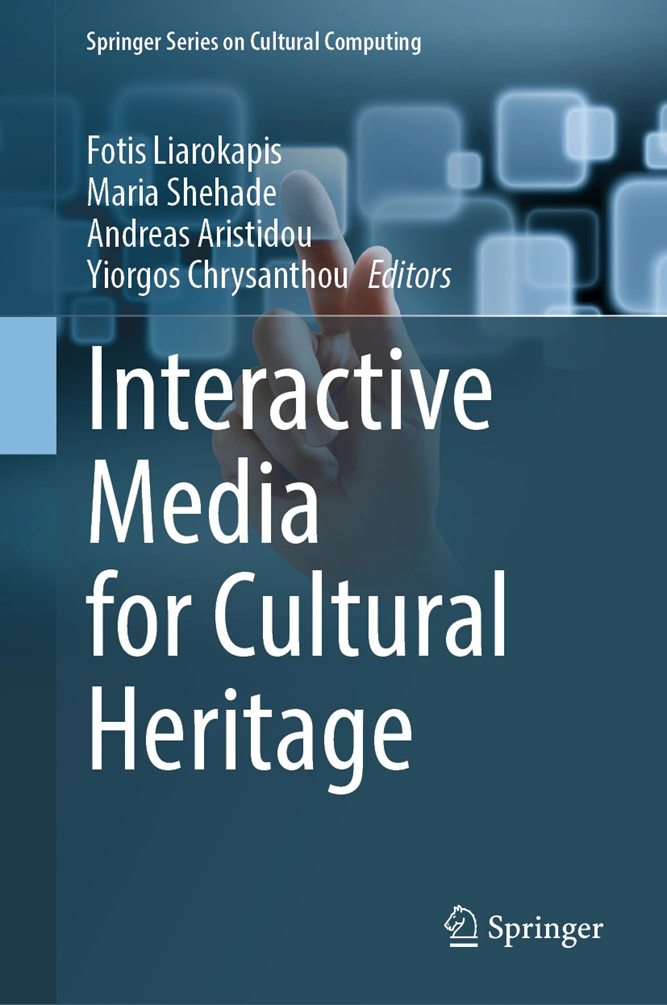
Interactive Media for Cultural Heritage

Recently, the latest edited book I co-authored with colleagues from CYENS – Centre of Excellence and the University of Cyprus was published by Springer Series on Cultural Computing. The book is entitled ‘Interactive Media for Cultural Heritage’ and presents the full range of interactive media technologies and their applications in Digital Cultural Heritage. It offers a forum for interaction and collaboration among the interactive media and cultural heritage research communities.

A close-up of a book cover

AI-generated content may be incorrect.

The aim of this book is to provide a point of reference for the latest advancements in the different fields of interactive media applied in Digital Cultural Heritage research, ranging from visual data acquisition, classification, analysis and synthesis, 3D modelling and reconstruction, to new forms of interactive media presentation, visualization and immersive experience provision via extended reality, collaborative spaces, serious games and digital storytelling.

More information:

https://link.springer.com/book/10.1007/978-3-031-61018-9

25 May 2024

Robotic Human Touch

A new robotic hand design developed in MIT's Computer Science and Artificial Intelligence Laboratory (CSAIL) has rethought the oft-overlooked palm. The new design uses advanced sensors for a highly sensitive touch, helping the extremity handle objects with more detailed and delicate precision.

GelPalm has a gel-based, flexible sensor embedded in the palm, drawing inspiration from the soft, deformable nature of human hands. The sensor uses a special color illumination tech that uses red, green, and blue LEDs to light an object, and a camera to capture reflections. This mixture generates detailed 3D surface models for precise robotic interactions.

More information:

https://news.mit.edu/2024/robotic-palm-mimics-human-touch-0520

27 February 2024

Adaptive Teaching Smart Glove

Researchers at MIT’s Computer Science and Artificial Intelligence Laboratory (CSAIL) have unveiled a groundbreaking development in wearable technology: a smart glove capable of providing tactile feedback to guide users through learning new skills, enhance robot manipulation precision, and aid in professional training.

Unlike conventional visual or auditory learning methods, the smart glove targets individuals who learn best through touch, a modality often overlooked in educational and training settings. The glove captures and reproduces touch-based instructions by seamlessly embedding tactile sensors and haptic actuators into textiles, enabling users to absorb knowledge in fields such as surgery, music, and beyond.

More information:

https://interestingengineering.com/innovation/mit-unveils-adaptive-smart-glove-that-makes-touch-the-teacher

31 January 2024

Phantom VR Glove

A VR startup based in Colorado, has developed a unique haptic glove called the Phantom. Unlike traditional VR gloves that cover the user's entire hand, the Phantom leaves the user's fingers uncovered. This would enable haptic feedback for hand-tracking applications on headsets like Quest 3 or Apple Vision Pro. The Phantom glove features a device with an electronics module and battery which is strapped around the wrist. 


This device also connects to five adjustable rings, one for each finger base. It connects wirelessly via Bluetooth to VR headsets. The rings stimulate the nerves that connect the fingertips to the brain. Through these stimuli, the glove tricks the brain into thinking it is actually touching something. The Phantom Glove would be one of the first models to provide tactile stimuli and feedback for hand tracking.

More information:

https://mixed-news.com/en/this-new-haptic-hand-tracking-glove-could-be-a-perfect-fit-for-the-apple-vision-pro/