22 February 2023

ChatGPT Controls Robots & Drones

Microsoft scientists are controlling robots and aerial drones with OpenAI's ChatGPT chatbot. The researchers used ChatGPT to simplify the process of programming software commands to guide robots, because the AI model was trained on massive datasets of human text. They initially outlined in a text prompt the various commands the model could use to control a given robot, which ChatGPT used to write the computer code for the robot. They programmed ChatGPT to fly a drone and have it perform actions, as well as to control a robot arm to assemble the Microsoft logo from wooden blocks.
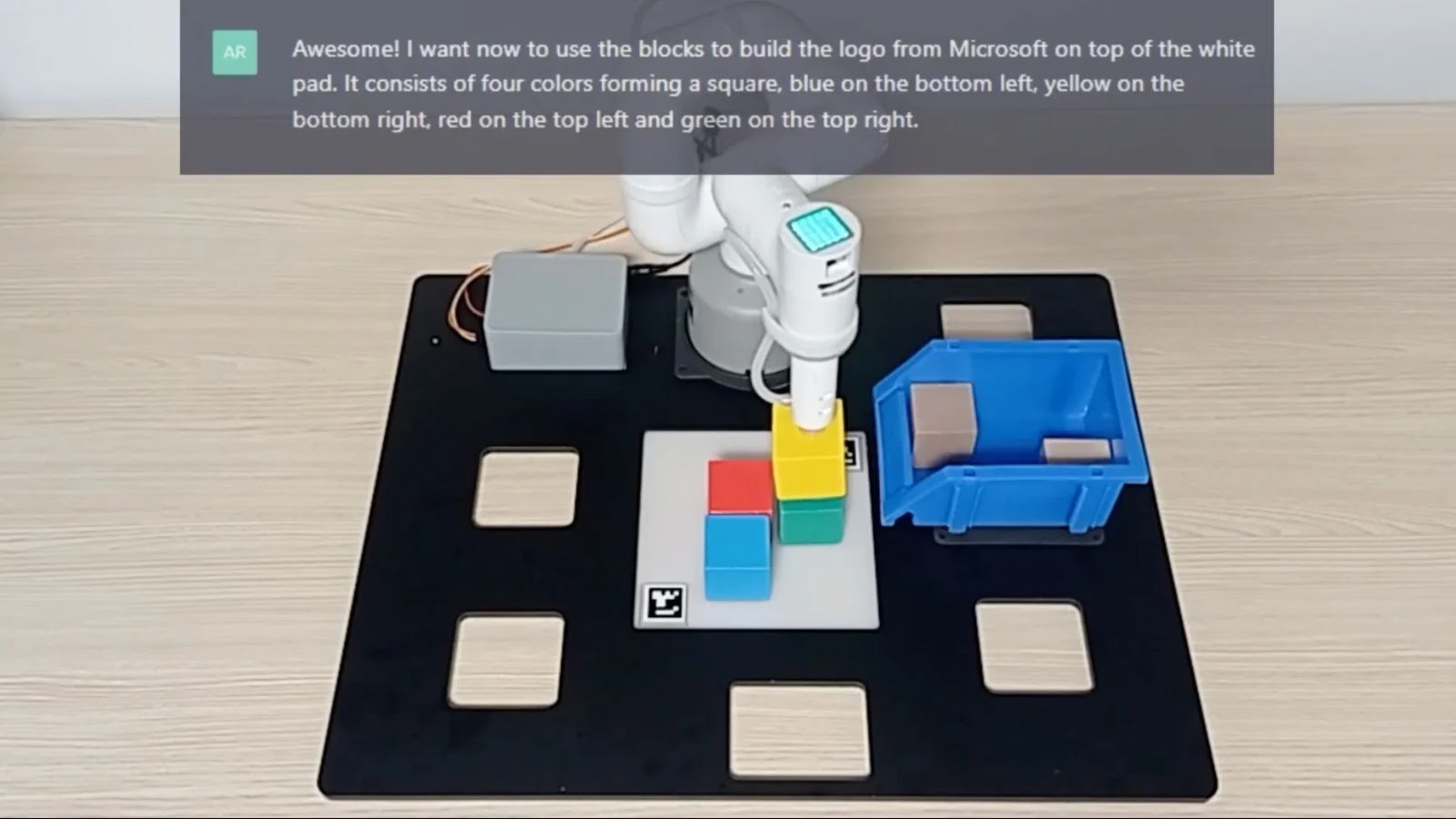
Although the research shows ChatGPT’s potential in robotics, the approach still has a key limitation: the chatbot can only write the computer code for the robot, based on the initial prompt or text-based request the human gives it. Hence, a human engineer must thoroughly explain to ChatGPT how the application programming interface for a robot works, otherwise the AI program will struggle to generate applicable computer code. Still, the other limitation is how it appears the robot needs to be constantly connected to ChatGPT.

More information:

https://www.pcmag.com/news/microsoft-researchers-are-using-chatgpt-to-control-robots-drones

21 February 2023

Drone Fly and Swims

A quadcopter that can fly like an aerial drone, but also splash down into water and operate like a submersible, could be used for search and rescue missions or engineering inspections. This drone can fly in the air or swim underwater using a dual-speed gearbox for each of its four motors.

The prototype device called Mirs-X, which weighs 1.63 kilograms and is 38 centimetres wide. It can hover for 6 minutes in the air or dive underwater for around 40 minutes. Mirs-X is waterproof at depths of up to 3 metres and moves at up to 2 metres per second in water.

More information:

https://www.newscientist.com/article/2357125-diving-drone-can-switch-between-flying-and-swimming/

10 February 2023

Sound Waves Create 3D Models

Scientists from the Micro, Nano and Molecular Systems Lab at the Max Planck Institute for Medical Research and the Institute for Molecular Systems Engineering and Advanced Materials at Heidelberg University have created a new technology to assemble matter in 3D. Their concept uses multiple acoustic holograms to generate pressure fields with which solid particles, gel beads and even biological cells can be printed. These results pave the way for novel 3D cell culture techniques with applications in biomedical engineering. 

Additive manufacturing or 3D printing enables the fabrication of complex parts from functional or biological materials. Conventional 3D printing can be a slow process, where objects are constructed one line or one layer at a time. Researchers in Heidelberg and Tübingen now demonstrate how to form a 3D object from smaller building blocks in just a single step. Using high-frequency ultrasound, which is inaudible to the human ear, the wavelengths can be pushed below a millimeter into the microscopic realm, which is used to manipulate very small building blocks, like biological cells.

More information:

https://techxplore.com/news/2023-02-3d.html