05 August 2024

BCI Controls Apple Vision Pro

Synchron has announced that it has successfully connected its brain implant to the Apple Vision Pro headset. This means that people with limited physical movement can now control the headset using only their thoughts. Synchron conducted the initial test on a 64-year-old man with ALS who played Solitaire, watched Apple TV, and sent text messages hands-free using Synchron's implant.

The man, otherwise couldn't use the headset because his loss of upper limb function meant he couldn't complete hand gestures required to use the Vision Pro. Synchron's brain-computer interface, or BCI, has been implanted in at least six US patients. The device is inserted through the jugular vein and delivered to blood vessels that rest on the brain's surface.

More information:
https://www.zdnet.com/article/apple-vision-pro-can-be-controlled-by-thoughts-now-thanks-to-bci-integration/

30 July 2024

Human Tears Power Smart Contacts

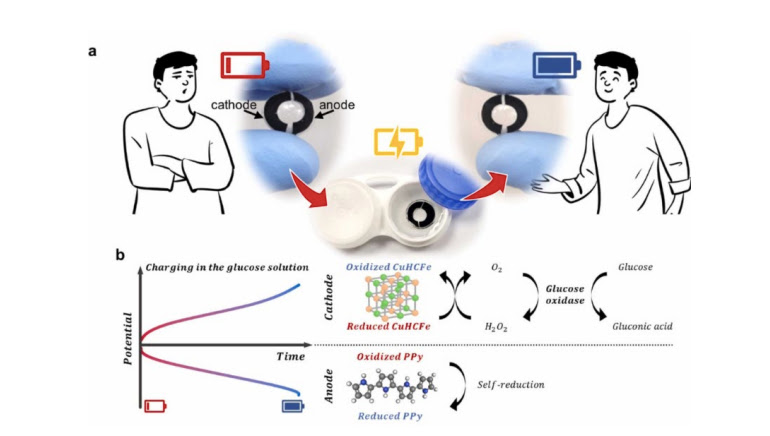
Scientists based out of Nanyang Technological University, Singapore (NTU Singapore) have begun working on augmented reality contact lenses capable of displaying virtual information in the real world powered by human tears. The team has begun development of a flexible battery roughly as thin as the human cornea. This ultra-slim battery can store electricity when in contact with a saline source, which can be found in tears.

According to researchers, this solution can extend battery life up to four hours for every 12-hour cycle. The contacts can also be charged using an external battery. The battery itself is made of biocompatible materials. No wires or toxic material were used in the development, promising a more comfortable experience compared to some other smart contacts. The team has already filed a patent and intends to commercialize the smart contacts at some point in the future.

More information:

https://vrscout.com/news/scientists-working-on-smart-contacts-powered-by-human-tears/

29 July 2024

Soft Robot Amputates and Reattaches

Researchers at Yale University have given a soft robot the ability to detach and reattach pieces of itself, editing its body morphology when necessary. The robot uses asymmetrically stiff air chambers that inflate and deflate to generate a walking or crawling motion. The joints rely on a new material called a bicontinuous thermoplastic foam (BTF) to form a supportive structure for a sticky polymer that’s solid at room temperature but can be easily melted.

The BTF acts like a sponge to prevent the polymer from running out all over the place when it melts, and means that you can pull two BTF surfaces apart by melting the joint, and stick them together again by reversing the procedure. The process takes about 10 minutes and the resulting joint is quite strong. It’s also good for a couple of hundred detach/re-attach cycles before degrading. It even stands up to dirt and water reasonably well.

More information:

https://spectrum.ieee.org/soft-modular-robot