13 October 2012

Personalised Digital Tabletop System

A tabletop system called PIVOT where users can come together and view shared content was unveiled a few days ago. A team of scientists, led by the University of Bristol, have developed the system aimed at supporting mixed-focus collaborative tasks. Through two view zones, PiVOT provides personalised views to individual users while presenting an unaffected and unobstructed shared view to all users.


The system supports multiple personalised views which can be present at the same spatial location and yet be only visible to the users it belongs to, a function that is not available in any other tabletop system. PiVOT also allows the creation of personal views that can be either 2D or auto-stereoscopic 3D images. PiVOT is a result of the exploration of different designs to address the opposing challenges of shared and personalised views. 

More information:

09 October 2012

Smartphone In Your Glasses

No need to turn to your smartphone to check the time, look at your agenda or the weather forecast, read a text message or map a route in an unfamiliar city. All this information, and much more, will soon be displayed on the lenses of augmented glasses via a mini-projector placed on the frames - and on the condition that you’re also wearing a specially designed pair of contact lenses. EPFL scientists in the Laboratory of Photonic Devices are currently working on a prototype that’s similar to the project announced this spring by Google. The applications envisioned for this eagerly awaited invention run the gamut – games, GPS, teaching enhancement, support for the deaf and hard of hearing, and myriad other kinds of augmented reality. To finalize a project like this, the team will have to overcome a number of technological challenges, the most formidable of which is finding a way to allow the user to simultaneously see the information displayed on the lenses – which are too close to the eye for it to be able to focus naturally on it – as well as see his or her surroundings. 


The researchers solved this problem by developing a specially designed contact lens with a micro-lens in its center that allows the eye to focus on the images. The Laboratory is working closely with EPFL start-up company Lemoptix, which specializes in miniaturized projection systems, to develop a high definition micro-projector that will blend discreetly into the right arm of the glasses. From this projector, images and information will be sent to the specially treated glasses lens via holography. This is a process in which the light scattered off of an object is recorded and then later reconstructed in 3D in the absence of the object. In the case of augmented glasses, the hologram will be projected on the lenses in such a way that the image is reflected in the direction of the eye, while the lenses still appear transparent. The user thus can still see through the glasses. Before this invention can be commercialized, however, all these technologies must be refined, tested, and put together. It will likely be between two and five years before we’ll be able to put on a pair of these glasses.

More information:

07 October 2012

Realistic Fluid Movements

What does a yoghurt look like over time? The food industry will soon be able to answer this question using a new fluid simulation tool developed by the Department of Computer Science (DIKU) at the University of Copenhagen as part of a broad partnership with other research institutions. An epoch-making shift in the way we simulate the physical world is now a reality. Results come from a five-year collaboration between the University of Copenhagen, the Technical University of Denmark (DTU). The new fluid simulation tool can boast of being very similar to physical reality. The method distinguishes itself significantly from known simulation methods which use mesh structures where the vertices are locked in a fixed position. 


In the new method, the mesh structure is replaced by a dynamic structure where the vertices move one at a time. This makes it possible to take account of the fluid’s physical properties more precisely and to see how different types of fluids interact with one another. The method also ensures such a high degree of detail that even very thin structures become visible. With previous statistical methods, it is often a problem that the simulated object’s edges and structures become blurred, and that its precise physical properties are hard to recreate. The new dynamic simulation method paves the way for countless applications. But for the time being, the method cannot be used by games developers because the simulation is extremely time-consuming as the vertices are moved one at a time.

More information:

30 September 2012

VSMM 2012 Paper

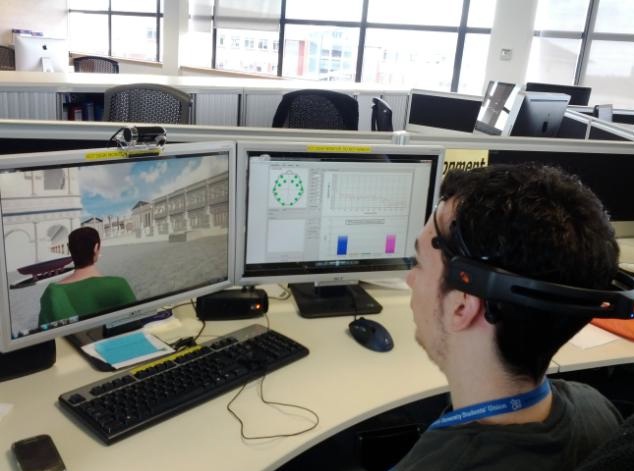
A few weeks ago, I presented a paper I co-authored with colleagues from Interactive Worlds Applied Research Group (iWARG) and the Serious Games Institute (SGI), was presented at the 18th International Conference on Virtual Systems and Multimedia, Virtual Systems in the Information Society (VSMM 2012). The conference took place at Milan, Italy, 2-5 September 2012 and the paper was titled ‘Brain-Controlled Serious Games for Cultural Heritage’.


The paper proposes a prototype system for cultural heritage based on brain computer interfaces for navigating and interacting with serious games. An interactive serious cultural heritage game was developed based on commercial BCI headsets controlling virtual agents in the ancient city of Rome. Initial results indicate that brain computer technologies can be very useful for the creation of interactive serious games.

A draft version of the paper can be downloaded from here.